Everyday Gold Jewelry Under $200: Everyday Gold Jewelry on a $200 Budget: What Doesn’t Fade and How to Style It
You buy a gold necklace. It looks perfect for three weeks. Then the back of your neck starts turning green, the clasp darkens, and the shine dulls to something closer to copper. You didn’t buy “fake” jewelry. You bought something labeled “gold” and assumed it would last. That assumption is exactly what most affordable jewelry brands count on.
The real problem isn’t your budget. It’s the vocabulary. Words like “gold tone,” “gold overlay,” and “gold plated” sound interchangeable but mean wildly different things for longevity. This article breaks down which gold jewelry types actually survive daily wear, which brands deliver under $200, and how to style pieces without looking like you tried too hard.
Gold Plated vs. Gold Vermeil vs. Gold Filled: What Actually Lasts
Most people walk into a store, see a shiny gold necklace, check the price, and buy it. That’s the entire decision process. But the label on the back of the card—or buried in the online product description—determines whether that piece lasts six months or six weeks.
Here’s the breakdown no salesperson will give you:
| Type | Gold Layer Thickness | Base Metal | Lifespan with Daily Wear | Price Range |
|---|---|---|---|---|
| Gold Plated | 0.5 microns or less | Brass, copper, steel | 1-6 months before fading | $15-$60 |
| Gold Vermeil | 2.5 microns minimum | Sterling silver (required) | 1-3 years with care | $60-$200 |
| Gold Filled | 5% gold by weight, mechanically bonded | Brass (usually) | 10-30 years | $40-$150 |
| Solid Gold | Solid throughout | Gold alloy (10k-24k) | Lifetime | $150+ for small pieces |
Gold vermeil is the sweet spot for under $200. It’s legally required to use sterling silver as the base and a thick layer of gold—at least 2.5 microns. That’s five times thicker than standard gold plating. When it eventually wears, it reveals silver underneath, not green-turning brass. Gold filled is even more durable but harder to find in trendy designs. Pavoi and Gorjana both offer vermeil pieces under $100 that hold up for years, not months.
The $200 Capsule: Which Pieces Earn Their Cost Per Wear

Spending $200 on one piece you wear twice a year is a waste. Spending it on three pieces you wear 200 days a year is a different equation entirely. The math matters here: a $65 necklace worn 150 times costs $0.43 per wear. That’s the metric to optimize for.
Three pieces cover 90% of everyday situations:
- A 16-18 inch chain necklace. Flat curb or cable chain, 1.2-1.8mm width. Thin enough to layer, substantial enough to wear alone. Mejuri’s Cable Chain Necklace in vermeil ($75) hits this perfectly.
- Small to medium hoop earrings. 15-25mm diameter. They frame the face without competing with a necklace. Gorjana’s Parker Hoops ($45) are hollow vermeil, so they’re lightweight enough for all-day wear.
- A single bracelet or ring. Pick whichever you’ll actually wear. Rings get more attention but bracelets catch light when you gesture. Missoma’s Mini Ridge Ring ($79) in vermeil has enough texture to look intentional without being flashy.
Total for all three: roughly $199. That’s a full everyday rotation that won’t trigger the green-neck panic three weeks in.
Why Most Affordable Gold Jewelry Fails (And How to Prevent It)
The failure isn’t random. It’s chemistry and friction, and both are predictable.
Gold plating fails fastest at contact points. The back of a necklace rubs against your collar. Ring shanks scrape against desks, steering wheels, and gym equipment. Earring posts sit in piercings where skin oils and sweat accumulate. These aren’t defects. They’re physics.
Three things destroy gold jewelry under $200 faster than anything else:
- Perfume and lotion applied after jewelry. The alcohol and oils create a film that accelerates tarnish. Spray first, let it dry completely, then put on jewelry.
- Showering in plated jewelry. Soap scum and hard water minerals build up in chain links and under settings. It’s not the water itself—it’s what’s in it.
- Storing pieces tangled together. Chains rub against each other. Clasps scratch softer gold surfaces. Store each piece separately, ideally in the little plastic bag it came in. Oxygen and humidity are the enemies; airtight storage adds months to a piece’s life.
One more thing nobody mentions: your body chemistry actually matters. Some people’s skin pH tarnishes gold plating in weeks regardless of quality. If you’ve had multiple pieces fail quickly across different brands, you might need to stick with gold filled or solid 10k gold. Pavoi’s gold filled collection starts at $38 and won’t react with skin chemistry the way plated metals do.
How to Style Gold Jewelry Without Looking Like You’re Trying
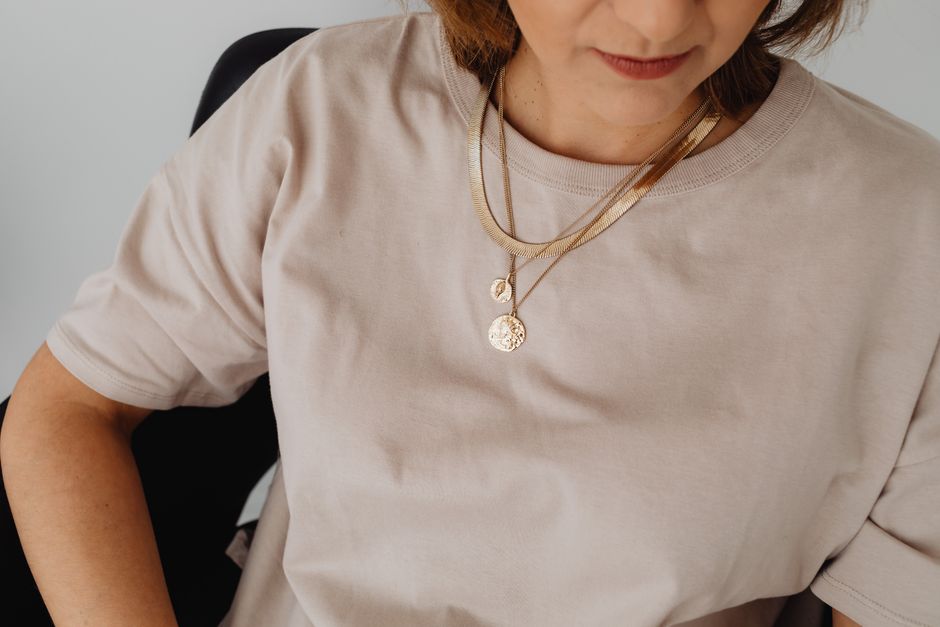
The difference between someone who looks put-together and someone who looks like they raided a jewelry counter is editing. Gold jewelry reads as expensive when there’s less of it, not more.
The rule that actually works: one focal point, one supporting piece, one bare zone. If you’re wearing a necklace that sits at your collarbone, your ears get small studs or nothing. If you’re wearing statement hoops, skip the necklace entirely. A bare décolletage with gold hoops looks intentional. A necklace plus earrings plus stacked rings plus a bracelet looks like you couldn’t decide.
For everyday gold, stick to one metal tone. Mixing gold and silver can work on a runway but reads as a mistake at a coffee shop. If your wedding rings are platinum, your everyday gold necklace will clash. Either commit to gold for the day or skip the necklace.
Neckline matters more than most people think. A crew neck t-shirt pairs best with a 16-inch chain that sits above the neckline. A v-neck or button-down calls for an 18-inch chain that follows the line of the opening. Turtlenecks want longer chains—20 inches or more—or skip the necklace and go for earrings instead. The jewelry should follow the clothing’s geometry, not fight it.
When to Skip Affordable Gold and Buy Solid Instead
There are exactly two situations where spending under $200 on gold jewelry is the wrong move.
First: engagement rings or wedding bands you’ll wear 24/7. Gold vermeil and gold filled rings will eventually show wear at the shank. For a piece you never remove, save for solid 10k or 14k gold. Even a thin solid gold band under $200 exists—look for 1mm 10k bands from Etsy sellers with verified reviews. They’re not impressive. They’re functional. But they’ll outlast any plated ring by decades.
Second: pieces with sentimental intent. If you’re buying something to hand down, gold vermeil isn’t it. The gold layer will wear through in a few years of daily use. Solid gold, even in a lower karat, becomes an heirloom. Gold filled is the compromise—it’ll last 10-30 years, which is long enough for most sentimental purposes but not generational.
For everything else—the everyday chain, the rotating hoop collection, the bracelet you wear to work—vermeil under $200 is the rational choice. Don’t let perfectionism push you into spending $500 on a necklace you’re afraid to wear.
Brands That Actually Deliver Under $200

Not all affordable jewelry brands are equal. Some use real vermeil. Others use misleading language around micron thickness. Here’s what holds up based on actual material specs, not marketing:
Mejuri dominates the $60-$150 vermeil space. Their gold vermeil uses 2.5 microns of 14k gold over sterling silver. The designs are minimal enough to wear daily. Their cable chain necklace ($75) and bold hoops ($85) are the entry points. They also offer solid 14k gold pieces starting around $150 for thin rings, which is rare at this price.
Gorjana runs slightly cheaper. Their vermeil Parker Hoops ($45) and Parker Necklace ($55) are lighter weight than Mejuri but use the same 2.5-micron standard. They’re better for earrings than necklaces—the lighter weight matters more when it’s hanging from your ears all day.
Missoma sits at the top of the budget. Their vermeil pieces run $79-$199. The Lucy Williams coin necklaces and ridge rings have enough texture and weight to feel substantial. The gold layer is thick enough that pieces survive daily wear for years, not months.
Pavoi is the budget pick. Their gold filled hoops start at $14 and their vermeil pieces at $38. The quality is inconsistent—check reviews for specific pieces—but when they get it right, it’s the best value under $50. Their gold filled huggies are the standout product.
One Chain, Five Outfits: The Only Styling Rule That Matters
You don’t need a jewelry box full of options. You need one chain that works with everything you already own. A 16-18 inch flat curb chain in gold vermeil is the closest thing to a universal piece in jewelry.
Here’s how one chain works across five real outfits:
- White t-shirt and jeans: Chain worn at 16 inches, sitting above the crew neck. No earrings. The chain does all the work.
- Button-down shirt, top two buttons open: Chain at 18 inches, falling just inside the open collar. Adds structure without competing with the shirt’s lines.
- Black turtleneck: Chain at 20 inches, worn over the fabric. The gold against black creates contrast. Small gold studs in ears, nothing else.
- Slip dress or v-neck: Chain at 18 inches, following the neckline’s angle. Add small hoops if you want more presence.
- Blazer and camisole: Chain tucked under the blazer lapel, just barely visible. It’s a detail, not a statement. That’s the point.
The chain doesn’t change. The length adjustment does the work. Most vermeil chains come with extender rings or adjustable clasps. Use them. A 2-inch length change completely shifts how the piece interacts with your clothing.
Spend the $75 on the Mejuri Cable Chain or the $55 on the Gorjana Parker. Wear it 200 days this year. At $0.27-$0.38 per wear, it’s the cheapest thing in your closet that’ll get the most compliments.