Fly High Butterfly
Picture this: you’re scrolling through Pinterest at 11pm, and every third pin is a woman in a sheer top covered in delicate butterfly prints, layered over a satin slip skirt, hair clips shaped like wings. It looks dreamy. It also looks like it could go very wrong very fast.
The fly high butterfly aesthetic sits at a specific intersection — feminine, nostalgic, slightly fantastical — and it’s been building momentum since the early 2026s. But what it actually means, which brands execute it without looking cheap, and how to wear it without veering into Halloween territory takes some unpacking.
Where the Fly High Butterfly Aesthetic Actually Comes From
Butterfly imagery in fashion isn’t new. Versace used butterfly prints as far back as the 1990s on silk scarves and resort pieces. Blumarine built an entire brand identity around butterfly motifs during the Y2K era, then watched a full revival happen between 2026 and 2026, with their archive pieces reselling at 3–4x original retail price on platforms like Vestiaire Collective and Depop.
The current fly high butterfly moment is rooted in three overlapping trends that collided at once: the Y2K revival (which brought back everything sheer, printed, and maximalist), the cottagecore aesthetic (nature imagery, soft romanticism, pastoral color palettes), and the broader fairy-ethereal trend that saturated fashion content from 2026 onward. The butterfly sits at the center of all three. It’s natural, it’s nostalgic, and it photographs exceptionally well.
What separates the fly high butterfly aesthetic from simply owning a butterfly-print top is intentionality. It’s not a single graphic tee from Target. It’s a cohesive design language that runs through prints, embroidery, silhouette references, and accessories — creating something elevated and otherworldly rather than novelty-item cheap. The difference is visible. You know it when you see it.
Blumarine’s Spring 2026 collection is the clearest high-fashion reference point for what the aesthetic looks like executed correctly. Mesh tops with hand-placed butterfly embroidery, low-rise skirts in papillon prints, knit dresses with wing-shaped cutouts. Retail prices ran $300–$1,200 per piece. The look it established became the visual template that mid-range and fast fashion brands immediately started chasing — which is why there was suddenly a butterfly print on every rack at every price point between 2026 and 2026.
The Y2K Connection That Actually Matters
Most people attribute the butterfly comeback entirely to Y2K nostalgia, and while that’s partially correct, it misses something important. The Y2K revival is driven largely by Gen Z — people who weren’t alive for the original moment — reconstructing it through a romanticized lens. That means the fly high butterfly version of Y2K isn’t a literal copy of 2001 fashion. It’s cleaner, more intentional, and harder to pull off well.
The original Y2K butterfly aesthetic (think Mariah Carey, early 2000s Cosmopolitan covers, rhinestone butterfly hairpins on everyone) was louder and more maximalist in a casual, accidental way. The current version strips that down and makes it deliberate. Reformation’s butterfly wrap dresses (~$248–$278) are a good example — undeniably butterfly-coded, but with modern construction, flattering silhouettes across multiple body types, and prints more restrained than anything from 2002.
Cottagecore vs. Fairy vs. Butterfly: The Distinction That Matters for Shopping
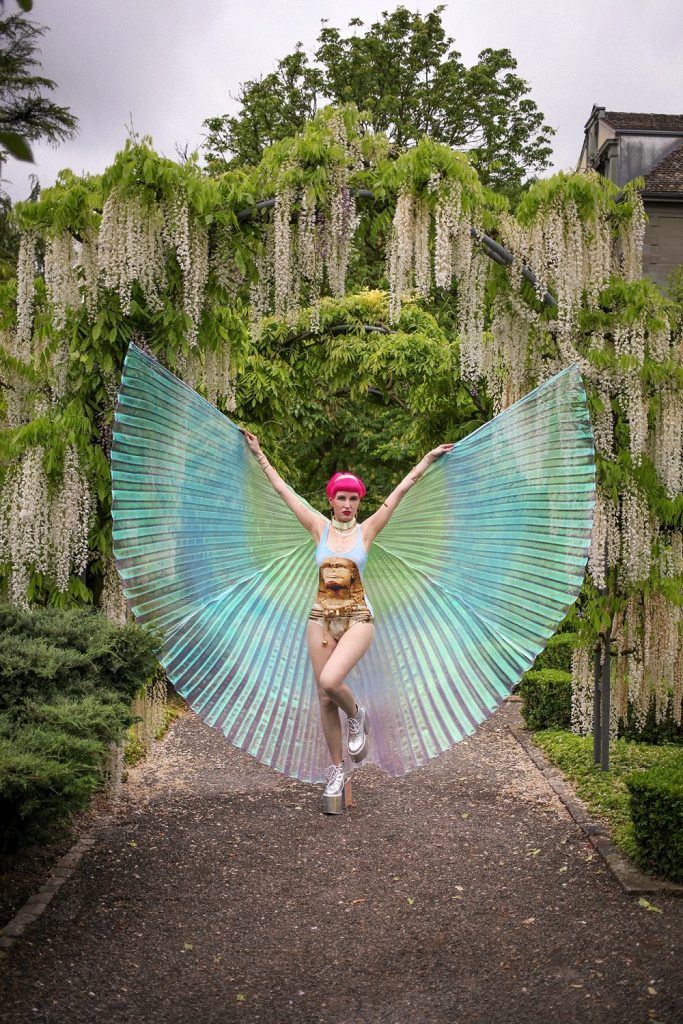
These three aesthetics share visual DNA but aren’t interchangeable, and confusing them leads to purchases you regret. Cottagecore is pastoral simplicity — linen, earthtones, prairie silhouettes, minimal skin. Fairy aesthetic goes maximally fantastical, with iridescent fabrics, dramatic wing accessories, and an unambiguously theatrical intent. Fly high butterfly sits between both: it borrows the natural-world romance of cottagecore and the whimsy of fairy fashion, but it’s more willing to be feminine and body-conscious — the low-rise moment, the bodysuit, the sheer layering — in ways cottagecore specifically avoids.
Understanding the distinction tells you what to actually buy. A cottagecore-coded butterfly blouse from Anthropologie (~$98) will read completely differently from a Blumarine-coded butterfly bodysuit at $450, even if both technically have butterfly prints. Wearing one and expecting it to read like the other is where the aesthetic falls apart.
Brands That Nail Butterfly Fashion at Every Price Point
Not all butterfly prints are equal. Here’s where the aesthetic lands across price points, and which brands consistently deliver versus which ones cut corners where it shows.
| Brand | Price Range | Best For | Watch Out For |
|---|---|---|---|
| Blumarine | $400–$1,500+ | High-fashion reference pieces, archive shopping | Sizing runs small; resale market has significant fakes |
| Reformation | $150–$350 | Wearable everyday butterfly pieces, modern fit | Prints change seasonally — buy when you see it |
| Zimmermann | $500–$1,200 | Premium butterfly embroidery, occasion wear | Worth the price for quality; wait for end-of-season sales |
| Free People | $60–$180 | Boho-butterfly overlap, festival styling | Quality varies significantly — check fabric content before buying |
| House of CB | $80–$220 | Going-out butterfly dresses, bodycon silhouettes | Strong trend pieces, limited long-term versatility |
| Urban Outfitters | $40–$120 | Y2K-coded casual pieces, layering items, accessories | Fast trend cycle — don’t spend over $60 here |
| ASOS | $25–$80 | Testing the aesthetic before committing money | Inconsistent quality; read every review before ordering |
The clearest verdict: if you’re spending real money, Reformation and Zimmermann are the two brands that consistently deliver butterfly pieces worth the investment. Reformation at $150–$350 gives you wearability and modern construction without a trend expiration date. Zimmermann at $500–$1,200 gives you craftsmanship — particularly on their embroidered pieces from lines like Luminosity — that holds up across multiple seasons.
At the budget end, ASOS and Urban Outfitters are serviceable for testing whether the aesthetic clicks for your wardrobe before committing to anything significant. Free People occupies an interesting middle ground — their butterfly pieces lean more boho than fashion-forward, which works for a specific customer (festivals, maximalist dressers) and falls flat for others.
How to Spot Quality in a Butterfly Print Before You Buy
With printed pieces, quality reveals itself in three places. First: registration — how precisely the print aligns at seams. On a cheap piece, butterflies get cut in half at side seams or shoulder seams with no attempt at matching. On a quality piece, the print continues deliberately across construction lines. Second: color depth — Blumarine uses 12–16 color separations in their signature prints. Most fast fashion uses 4–6. The difference is immediately visible in person, even if online photos flatten it out. Third: fabric hand — does the material feel like it was chosen specifically for this print, or does it feel like the print was slapped onto whatever base fabric was cheapest?
For embroidered butterfly pieces specifically, look at stitch density and whether the embroidery has dimension. Good butterfly embroidery lifts slightly off the fabric surface. Flat embroidery on a thin base fabric is a reliable sign of a piece that won’t survive 20 washes.
The One Rule That Separates Butterfly Fashion From a Costume
One butterfly statement piece per outfit. Maximum. Not two. Not three.
A butterfly-print midi dress doesn’t need butterfly hair clips AND a butterfly-shaped bag. It needs clean, quiet supporting pieces — a solid sandal, minimal jewelry, a bag in a coordinating solid. The butterfly piece is doing the work. Let it do it alone.
How to Build a Fly High Butterfly Outfit That Works
The actual process of building this look without tipping into fancy dress breaks down into four decisions made in order — and the sequence matters.
- Choose your hero piece first. Is it a print, an embroidered item, or a silhouette with wing-like design elements (flutter sleeves, asymmetric hems, cape backs)? Your hero piece determines every other decision.
- Identify what the hero piece does to body proportion. A voluminous butterfly-print blouse needs slim-cut bottoms. A fitted butterfly-print bodysuit can handle a fuller or more draped skirt. Never layer volume on volume.
- Pick supporting pieces in solid, muted tones pulled from within the print’s existing color palette. If your Reformation butterfly dress has dusty rose and sage green in the pattern, your bag and shoes should echo one of those two colors — not introduce a third.
- Limit additional butterfly motifs to one small accent at most. Butterfly clips are fine if the dress is the hero. Delicate butterfly earrings are fine. Not both simultaneously.
Specific combinations that consistently land well:
- Butterfly-print slip dress + fitted white cardigan + brown leather mules — the most wearable combination, flattering across body types, appropriate for day and low-key evening
- Butterfly-embroidered corset top + wide-leg dark denim + block-heeled ankle boots — the Y2K-forward version, works for going out without being overtly dressed up
- Sheer butterfly-print blouse + satin slip skirt in a coordinating solid + strappy heeled sandals — the dressier option, appropriate for dinners, events, gallery openings
- Oversized butterfly-graphic knit + fitted cycling shorts + platform sneakers — the street-style casual take, borrowed directly from the early 2026s sportswear-meets-feminine moment
What consistently doesn’t work: mixing two different butterfly prints in the same outfit as though they’re a coordinated set. Unless you’re wearing a literal matching set designed together (Free People and House of CB have both released these), two different butterfly prints in one look compete visually. Neither reads as intentional; both read as accidental.
Accessories That Complement Without Over-Theming
Butterfly hair clips are the most obviously on-theme accessory choice — and they do work when you choose the right version. The large sculptural 3D clips (Lelet NY makes well-regarded ones at $30–$60 per piece) add texture and read as deliberate. The tiny flat plastic butterfly clips read as children’s accessories and undercut an otherwise adult look.
Beyond clips, the accessories that complement butterfly fashion most effectively are unexpectedly understated: delicate gold chain necklaces, small hoop earrings, barely-there strappy sandals in nude, tan, or white. The butterfly piece has personality. Everything else should play quiet.
Common Questions About Wearing Butterfly Fashion
Can you actually wear butterfly fashion to work?
Yes — in most environments, with one condition: colorway discipline. A butterfly-print blouse in a muted palette (navy and cream, black and ivory, dusty rose and sage) tucked into tailored trousers is a genuinely professional look. Reformation’s Roohi Blouse (~$178 when available) in their more restrained colorways works well in business casual offices. What doesn’t translate to most professional settings: anything sheer without opaque layering, anything with cutouts, anything in a maximalist neon colorway. The aesthetic itself isn’t inherently casual — the execution determines how it reads.
Does age matter when wearing butterfly fashion?
The answer is always the same regardless of which trend aesthetic is being asked about: it’s execution that matters, not age. A woman in her 50s wearing a Zimmermann butterfly-embroidered dress looks extraordinary. The same woman in a polyester butterfly-graphic crop top from ASOS might not — but that’s a fabric and construction problem, not an age problem. At higher price points, butterfly fashion is legitimately elegant. What reads as juvenile is almost always cheap fabric and construction, not the motif itself.
Which butterfly pieces are worth investing in versus which are trend-only buys?
Trend pieces are items where the butterfly motif is the entire value proposition — the graphic tee that only works because butterflies are having a moment, the novelty accessory, the fast-fashion print that looks exactly like what’s on the mood board this season. These have a one-to-two season lifespan before they read as dated.
Investment pieces are items where butterfly imagery is part of a broader, consistent design identity — Blumarine’s signature prints that have been central to the brand since the 1970s, Zimmermann’s hand-embroidered occasion pieces, a Reformation dress in a classic silhouette that happens to use butterfly fabric. These don’t expire the same way because they’re not trend-chasing; they’re expressing a design language with staying power.
The practical test: if you’d still wear it in a world where butterflies specifically had gone out of fashion, it’s a solid buy. If the entire case for owning it depends on butterflies being trending right now — buy it cheap or skip it entirely.