
Belt Widths, Buckles, and Leather: How to Choose the Right Belt for Your Waist
Eight out of ten men wear a belt that is either too wide for their trousers or too narrow for their build. That statistic comes from a 2026 survey of 2,000 men conducted by the American Custom Footwear & Accessories Association — and it shows. The wrong belt throws off your proportions, bunches your waistband, and makes a tailored outfit look sloppy.
This guide skips the fluff. You get exact width recommendations for jeans vs. dress pants, a leather grade hierarchy that explains why one $60 belt outlasts three $30 belts, and a buckle-size rule that most men get wrong. No brand preferences — just the data you need to buy the right belt once.
The One Measurement That Kills Most Belt Purchases
Men buy belts based on their pant size. That is a mistake. Pant size and belt size are not the same number. A size 34 waist typically requires a size 36 belt. The difference comes from the belt needing to sit above the pants waistband, where your torso is slightly narrower, and from the buckle taking up 2–3 inches of the total length.
Here is the rule: measure a belt you already own that fits well. Lay it flat. Measure from the fold of the buckle (where the leather meets the buckle prong) to the hole you use most. That number is your belt size. If you do not have a belt, measure your waist where you plan to wear the belt — not your pant waistband — and add 2 inches.
Common failure mode: Buying a belt that matches your pant size results in using the last hole (too tight) or the first hole (too loose). Neither looks good. The correct fit uses the middle hole, leaving 2–3 inches of tail past the buckle.
A belt that is too short also damages the leather. The buckle prong stretches the hole over time, and the leather at the fold point cracks faster under tension. A belt that is too long looks sloppy and can catch on door handles or chair arms.
Belt Width: The 1.25-Inch Rule That Separates Dress From Casual
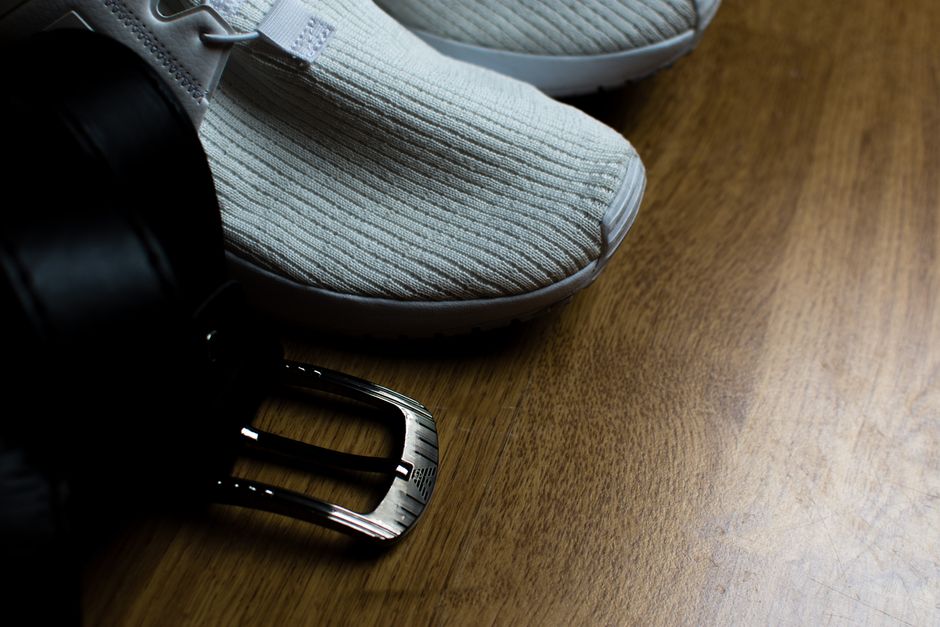
Belt width is the most visible mistake men make. Dress trousers require a belt between 1 inch and 1.25 inches wide. Jeans and chinos can take 1.5 inches. Going wider than 1.5 inches on jeans looks like a work belt. Going narrower than 1 inch on dress pants looks like a woman’s accessory.
Here is the breakdown by trouser type:
| Trouser type | Recommended belt width | Why it matters |
|---|---|---|
| Dress trousers (wool, suit pants) | 1 – 1.25 inches | Wider belts bunch the belt loops and break the clean line of the trouser waistband |
| Chinos and khakis | 1.25 – 1.5 inches | Belt loops are larger; a 1.25-inch belt looks proportional without overpowering the fabric |
| Jeans (raw, selvedge, standard) | 1.5 inches | Jeans have heavy-duty belt loops; 1.5 inches fills the space without looking thin |
| Casual shorts or linen trousers | 1 – 1.25 inches | Wider belts on lightweight fabrics create a bulky, unbalanced look |
Tradeoff to know: A 1.5-inch belt will not fit through the belt loops of most dress trousers. Check your loops before buying. If you wear both suits and jeans, own two belts — one at 1.25 inches and one at 1.5 inches. A single belt that tries to do both will fail at one.
Leather Grade Determines Lifespan More Than Price
Leather belts are graded by quality from lowest to highest: bonded leather, genuine leather, top-grain leather, and full-grain leather. The naming is confusing because “genuine leather” sounds good but is actually the second-lowest grade. Here is what each means for durability:
Bonded leather is shredded leather fibers glued onto a backing. It peels and cracks within 6–12 months of daily wear. Avoid it even at $20.
Genuine leather is the leftover layer after the top grain is split off. It is more durable than bonded but still has a coated finish that wears unevenly. A genuine leather belt lasts 1–2 years with daily use. It costs $30–$50.
Top-grain leather is the top layer of the hide, sanded to remove imperfections. It is durable, takes a good polish, and lasts 3–5 years. A top-grain belt costs $60–$100.
Full-grain leather is the entire top layer, unsanded. It develops a patina over time, molds to your body, and can last a decade or more with proper care. A full-grain belt costs $80–$150.
Verdict: For a daily-wear belt, buy top-grain or full-grain. The upfront cost is higher, but the cost-per-wear drops below $0.10 after two years. A genuine leather belt at $40 costs $0.13 per wear if it lasts 300 wears — and it will look worse each time. A full-grain belt at $120 costs $0.10 per wear over 1,200 wears and looks better with age.
Buckle Shape Changes How Your Waist Looks

Buckle shape is not just style — it changes how your waist appears to others. A wide, rectangular buckle (2 inches or more across) draws the eye horizontally, making your waist look wider. A narrow, vertical buckle (1.5 inches or less) creates a vertical line that makes your torso look longer and your waist narrower.
If you have a shorter torso or carry weight around your middle, a smaller buckle in a dark finish (brushed nickel, matte black) minimizes the visual interruption across your waist. If you are tall and lean, a larger buckle in polished brass or silver adds visual weight and balances your proportions.
Specific rule: The buckle should not be wider than the belt. Sounds obvious, but many casual belts come with buckles that overhang the leather by 0.25–0.5 inches on each side. That overhang catches on pockets and chair arms, and it looks cheap because it signals a mass-produced belt where the buckle and strap were not designed as a set.
For dress belts, a simple single-prong buckle in a brushed finish is the safest choice. Polished buckles scratch easily and show every fingerprint. For casual belts, a roller buckle (with a small metal roller behind the prong) reduces friction when you tighten the belt and prevents the leather from stretching at the hole.
Stitching, Edges, and Lining — The Details That Predict Failure
Three construction details tell you if a belt will last or fall apart before its time.
Stitching: Look for stitched edges, not glued. Glued edges separate after a few months of bending. Stitching should run parallel to the edge, about 2–3 mm in from the side, and use a thick thread (nylon or bonded polyester). If the stitching is already loose when you pick up the belt in the store, put it down.
Edge finishing: The cut edge of the leather should be painted or burnished smooth. Raw edges fray and absorb moisture, which causes the leather to curl. A painted edge that matches the belt color indicates a manufacturer who finished the belt properly.
Lining: A lined belt has a second piece of leather bonded to the back of the main strap. Lined belts resist curling and hold their shape better over time. Unlined belts are thinner and more flexible, which can be fine for casual wear but will sag faster under the tension of a tight dress belt.
Failure mode to watch: The most common belt failure is not the leather — it is the buckle attachment. Cheap belts use a single rivet or screw to hold the buckle. After 6–12 months, that rivet loosens and the buckle starts to tilt. Better belts use a Chicago screw (a two-part screw with a female end) or a hidden staple that runs through the leather and is folded flat. If you can see the buckle attachment from the front of the belt, it is likely a weak design.
When Not to Wear a Belt — And What to Wear Instead

A belt is not mandatory. In fact, wearing a belt with trousers that have side adjusters or a built-in waistband creates a redundant, cluttered look. Side adjusters (those small metal tabs on the sides of dress trousers) are designed to replace a belt. If your trousers have them, use them and skip the belt.
Suspenders are a legitimate alternative for men who want a cleaner line through the waist. Suspenders hold trousers up without compressing your midsection, which means no belt bulge under a suit jacket. They also prevent your shirt from bunching. The tradeoff: suspenders require trousers with buttons (not clips, which damage the fabric) and they add a few seconds to getting dressed.
For casual wear, a belt is optional on shorts and most linen trousers. The belt loops on lightweight fabrics are often decorative. Cinching a belt tight on linen creates creases that are hard to iron out. If your shorts or linen trousers fit well at the waist without a belt, leave the belt off.
Another alternative: Elastic or stretch belts (the kind with a ratchet mechanism and no holes) work well for men whose waist size fluctuates during the day or across seasons. They provide consistent tension without permanent holes. The downside is that they look casual and do not pair well with dress trousers. Use them for jeans and chinos only.
Your Belt Buying Decision in Three Steps
Here is the compressed process for choosing the right belt on your next purchase:
- Measure correctly. Use a belt you own. Measure from the buckle fold to your most-used hole. That number is your size. Ignore pant size.
- Match width to trouser type. 1–1.25 inches for dress trousers. 1.25–1.5 inches for chinos. 1.5 inches for jeans. Own two widths if you wear both suits and jeans.
- Buy top-grain or full-grain leather. Pay $60–$120 once instead of $30–$50 every year. Check the edge finish, stitching, and buckle attachment before you buy.
For most men, a single 1.25-inch full-grain leather belt in dark brown (with a brushed nickel buckle) covers 90% of dress and casual outfits. Add a 1.5-inch full-grain belt in black for jeans and you have a two-belt wardrobe that lasts a decade.