
Professional Interview Attire For Women: Interview Attire for Women: The 2026 No-BS Dress Code
Let’s get one thing straight: the old rulebook that says you must wear a black pantsuit and a white button-down to every interview is dead. It’s been dead for years, but hiring managers tell me people still show up looking like they’re attending a funeral for their own personality. The 2026 standard is about looking polished, capable, and comfortable—not like you raided a 2008 bank teller’s closet.
You have roughly 7 seconds before someone forms an opinion. You want that opinion to be “she’s sharp” and not “she’s uncomfortable.” This guide breaks down what actually works now, what makes you look outdated, and how to build an outfit that lets you focus on your answers instead of your waistband.
The New Baseline: Why the Suit is Optional (But Structure Isn’t)
For decades, the suit was a uniform of conformity. It signaled you understood the rules. In 2026, the rules have shifted. Remote work, hybrid offices, and a general relaxation of dress codes mean that a full matching suit can sometimes read as too stiff for a creative or tech role. However, the core principle of the suit remains non-negotiable: structure.
If you ditch the blazer, you need to replace the authority it provides with something else. That usually means a sharp knit top with a defined shoulder, a tailored dress with a substantial fabric weight, or a longline vest. You cannot show up in a cardigan and a shell top and expect to command the room. The fabric needs to hold its shape.
The Fabric Test
- Pass: Wool blends, heavy crepe, ponte knit (thick enough to not show bra lines), structured cotton twill.
- Fail: Linen (wrinkles instantly), thin rayon, slinky jersey, anything see-through.
If you are interviewing in finance, law, or C-suite consulting, keep the suit. It’s still the uniform. The Theory Treeca Good Wool Blazer and matching trousers are the gold standard, but the Ann Taylor Seasonless Stretch Suit is a solid budget alternative that doesn’t look cheap.
Color Psychology: The “Trust Me” Palette
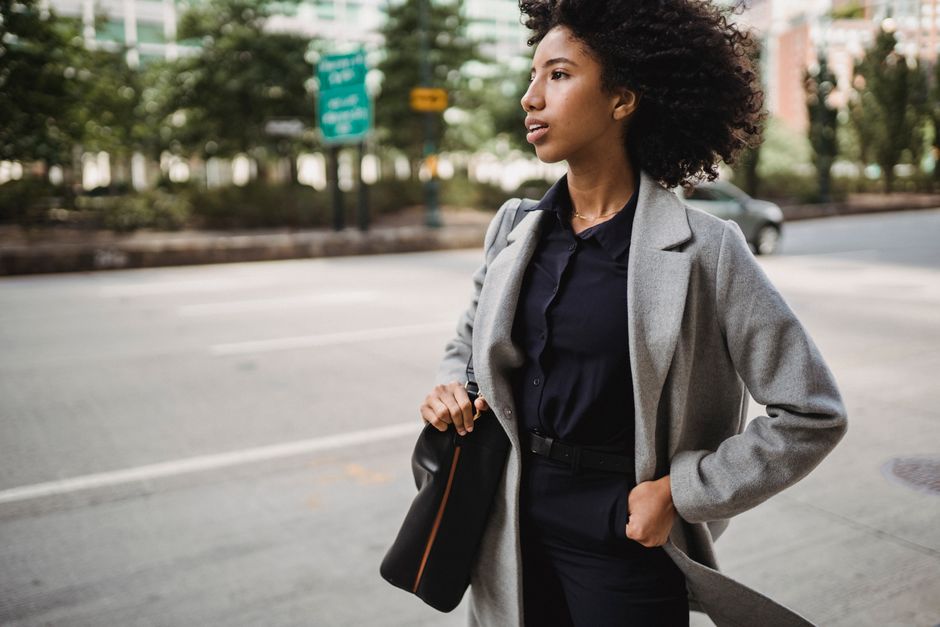
You don’t need to wear black. In fact, black can sometimes wash you out on a Zoom screen or make you look severe in a bright office. The goal is to look alert and approachable.
The safe zone in 2026 revolves around deep, muted tones that read as professional on camera and in person. Navy is the undisputed king—it’s softer than black but just as authoritative. Charcoal grey, deep burgundy, dark forest green, and rich camel work well.
| Color | Vibe it Projects | Best For | Risk Level |
|---|---|---|---|
| Navy | Trustworthy, calm, competent | All industries, first interviews | Low |
| Charcoal Grey | Analytical, serious | Tech, engineering, finance | Low |
| Burgundy/Oxblood | Confident, creative | Marketing, design, law | Medium |
| Bright White | Stark, high contrast | Better as a base layer than a full suit | Medium (stains, glare) |
| Pastels (Pink, Lilac) | Soft, youthful | Education, non-profits, entry-level | Medium (can read junior) |
The Three Formulas That Work Every Time
Stop overthinking it. You need one of these three combinations. That’s it.
Formula 1: The “Modern Executive” (Traditional Industries)
This is for banking, law, government, or any place with a formal dress code. You want a matching suit or a structured dress with a blazer.
- Top: Shell or blouse in silk or high-quality polyester (avoid cheap sheen).
- Bottom: Tapered trousers or a pencil skirt that hits at or below the knee.
- Shoes: Low block heel or pointed-toe flat. Cole Haan Grand Ambition Pump or Rothy’s The Point.
Formula 2: The “Smart Casual Authority” (Tech/Startups/Creative)
This is where you can relax, but not too much. You want to look expensive and intentional, not like you just rolled out of a coffee shop.
- Top: A fine-gauge merino wool sweater or a structured knit top. The Everlane The Cashmere Crew works, but only if it’s not pilling.
- Bottom: Wide-leg trousers or dark-wash denim (only if the company culture explicitly says jeans are okay—check their Instagram first). The Aritzia Effortless Pant is a safe bet.
- Shoes: Clean leather sneakers (white, minimal) or loafers. Madewell The Lorimer Loafer.
Formula 3: The “One-Piece Solution” (When You’re Short on Time)
A structured dress removes the matching problem entirely. It’s one decision. It looks put-together even if you’re panicking inside.
- Pick: A sheath dress in a thick ponte or wool blend. MM LaFleur The Origami Dress is a cult favorite for a reason—it fits like a glove and doesn’t wrinkle.
- Layer: A longline blazer or a duster cardigan in a contrasting neutral.
Accessories: The Difference Between “Trying” and “Arriving”

Here’s where most people blow it. They nail the suit, then ruin it with a beat-up tote bag, chipped nail polish, or jangly jewelry that clinks against the table every time they gesture.
Keep it minimal. You want the interviewer looking at your face, not your earrings.
- Bag: A structured tote or a sleek backpack. The Cuyana Classic Structured Tote looks far more expensive than it is. No logos, no canvas beach bags.
- Jewelry: One pair of studs (small hoops or diamond/CZ studs). A simple necklace. The Mejuri Bold Hoops are a good size—visible but not distracting.
- Watch: A simple metal or leather-strap watch. It subconsciously signals you respect time.
The Zoom Interview Trap (And How to Avoid It)
Remote interviews have their own rules. What looks good in your bedroom mirror might look like a mess on a webcam. The camera flattens everything and washes out color.
Do a test run 24 hours before. Open your laptop camera. Sit where you’ll sit. Look at the screen.
- If your top blends into the wall: Change your top or change your background. You need contrast.
- If you look tired: Add more light in front of you, not behind you.
- If your neckline is gaping when you sit: Wear a higher neckline or a structured jacket. You don’t want to be tugging at your shirt on camera.
For video, solid colors are better than busy patterns. Small patterns can cause a moiré effect (that weird shimmering) on camera. A solid navy or jewel-toned top is perfect.
What To Do When You’re Completely Lost

If you’ve read all this and you’re still staring at your closet with panic, here’s the emergency protocol.
Go to J.Crew or Banana Republic. Buy a navy blazer, a white or light blue silk blouse, and a pair of grey or navy trousers. Buy the Cole Haan Grand Ambition Pump in black or nude. That’s it. That outfit will pass the dress code in 95% of interviews in North America.
Don’t overthink it. The goal is to remove the clothing variable so you can focus on the conversation. You want them to remember what you said, not what you wore. That’s the whole point.